


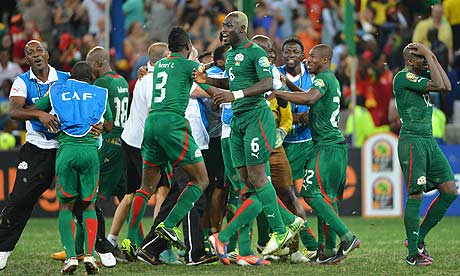
 Burkina Faso players celebrate after beating Ghana to reach the 2013 Africa Cup of Nations final.
Nigeria's opponents in final prove that the continent's middle-ranking teams can take on and beat Africa's best.
To the question of where African football is progressing, there
are two answers. On the one hand, it has stagnated, perhaps even gone
backwards: we are no closer to an African team winning the World Cup now
than we were when Cameroon reached the quarter-finals in 1990 (yes,
Ghana were within a Luis Suárez handball and an Asamoah Gyan missed
penalty of becoming the first African side to reach a semi-final, but
they would also have gone out in the first round had an Australian
handball with two minutes of their final group game remaining been
punished and Serbia converted the penalty; stuff happens).
And yet in an another way it has improved immeasurably: the top may not have progressed but the middle certainly has and Mali, Angola, Togo and Cape Verde – even Gabon and Sudan, although neither qualified for this Cup of Nations – are all teams worthy of respect, capable of taking on the best their continent has to offer. The pyramid of talent may not have got higher, but it has got broader.
And yet in an another way it has improved immeasurably: the top may not have progressed but the middle certainly has and Mali, Angola, Togo and Cape Verde – even Gabon and Sudan, although neither qualified for this Cup of Nations – are all teams worthy of respect, capable of taking on the best their continent has to offer. The pyramid of talent may not have got higher, but it has got broader.
-->
"You can no longer differentiate so much between which teams are better," said the Nigeria
coach, Stephen Keshi, earlier in the tournament. "In the old days you
could predict how many goals one team was going to score against the
other but now you don't know what is going to happen. You might think
one side will win but you don't know. I think this is wonderful for
African football. The competition is so tight: you look at the likes of
Ethiopia and Cape Verde and some of the other countries. I am very
impressed with their performances and the standard they are reaching."
Burkina Faso,
the team Nigeria face in Sunday's final, are the latest example of
that. Their story does not have the tragic dimensions of Zambia last
year, returning to Libreville 19 years after the air crash there that
killed 18 of their players to win with the 18th penalty in the shootout,
but it is a fairytale nonetheless.
As a column by Le Fou in Le Pays,
the Ouagadougou-based national, put it: "Anyone who does not believe in
miracles is not a realist." He went on to complain about how "wild"
fans had been in their celebrations, keeping him up all night with their
noise, which gives some indication of what the reaction has been back
in Burkina Faso.
When the Stallions left Ouagadougou, their goal
was to win one game, something they hadn't done since hosting the
tournament in 1998, when victories over Algeria and Guinea took them
through to a quarter-final against Tunisia. They won that on penalties
before going out to the eventual champions Egypt in the semi-final.
Burkina Faso then led DR Congo 4-1 in the third-placed play-off with
four minutes remaining, only to concede three times and lose on
penalties.
In fact, in 26 previous matches at the finals, Burkina
Faso had won only two games, drawing six and losing 18. Away from home
soil, they had gathered four points from a possible 60. Last year, in
Equatorial Guinea, having been extremely fortunate to have been allowed
to compete after fielding an ineligible player in a qualifier against
Namibia, Burkina Faso were a shambles and lost all three matches.
Whether Paul Put can truly regain redemption in Africa for his involvement in the Ye Zheyun match-fixing scandal in Belgium
is debatable, but what cannot be doubted is the quality of the job he
has done since leaving Europe, first with Gambia and then with Burkina
Faso. Their captain, Charles Kaboré, paid immediate tribute to Put after
the semi-final victory over Ghana,
while there was surely significance in the way Aristide Bancé raced to
the touchline to hug his coach after Emmanuel Agyemang-Badu had seen the
decisive penalty in the shootout saved.
There is a wonderful photograph of the two,
one peroxide blond, the other with his sandy hair bleached by the sun,
both with mouths wide in triumph, arms outstretched like long-lost
lovers, about to embrace on the painted sand of the Mbombela as the
plague of moths that blighted the stadium flit around them, illuminated
in the floodlights like an eddy of snow. ("Is it still mothing? I hadn't
noticed …" as Andie MacDowell might say in the unlikely event she is
called upon to play the Belgian in a biopic, Four Draws and A Single Win
in Normal Time).
To quibble that Burkina Faso progressed thanks to draws is slightly to miss the point. They more than held their own against Nigeria in the opener
and probably deserved the injury-time equaliser that Alain Traoré
scored in the final moments. They overcame the dismissal of their
goalkeeper Abdoulaye Soulama with the score at 1-0 to pick off Ethiopia
on the break and win 4-0, becoming the only side in eight games to
manage more than a single goal on the Mbombela pitch – the first sign
that adversity becomes them. Needing a draw to progress, they played
calm, containing football to force a 0-0 in their final group game against Zambia. "There was more pepper than salt in the soup today," said Put, meaningfully, after that game.
They
lost Traoré to a thigh injury in that match but Bancé, while lacking
Traoré's finishing, has stepped in and done an admirable job of leading
the line, with Jonathan Pitroipa providing creativity from wide. It was
Pitroipa who headed the winner in extra time after a cagey quarter-final against Togo
and he was superb again in the thrilling semi against Ghana. Put had
spoken of his side's growing maturity and there was something highly
impressive about the way they overcame not merely the setback of going
behind but also a string of baffling refereeing decisions going against
them (although those who insist that the Tunisian referee Slim Jdidi was
biased against Burkina Faso may like to consider why he showed a yellow
rather than a red card to Keba Paul Koulibaly when he kicked out at
Gyan). On another day they would have had two penalties, Ghana would not
have had theirs, and Prejuce Nakoulma's late goal would not have been
ruled out for some banal jostling with Kwadwo Asamoah.
And, most
crucially of all, Pitroipa would not have been sent off with four
minutes remaining after collecting a second yellow card for a supposed
dive when he was clearly whacked across the knees by John Boye. To be
without him as well as the injured Traoré for Sunday's final would be a
severe blow, but Jdidi admitted on Friday morning that he had made a
mistake and it is almost certain the Confederation of African Football
will overturn the forward's suspension at a meeting on Friday afternoon.
"If
I had lost it or lost my temper I think all my teammates would have
followed me," said Kaboré. "It was my responsibility to keep calm." He
did and so did his team-mates. It was Ghana who panicked in the penalty
shootout, Isaac Vorsah and Emmanuel Clottey both dragging their shots
wide of the target, opening the way for the Stallions to reach an
entirely unexpected final.
Nigeria, riding a wave of new-found
self-belief, are the most formidable test yet, but Burkina Faso have
overcome every obstacle so far. Hervé Renard, the Zambia coach,
suggested CAF did not want his side representing Africa at this summer's
Confederations Cup, but presumably replacing them with Burkina Faso was
not part of the plan. The broadening of the pyramid may be a positive
for Africa in the long run, but anybody who ends up with tickets for
Burkina Faso against Tahiti in Belo Horizonte on 17 June is unlikely to
agree.



0 commentaires:
Post a Comment